
Australia’s connection points to the global internet are vulnerable in this era of concern about increased hi-tech warfare. Undersea cables essentially carry all of the data to and from the country – without them, we go dark losing internet, phone, or other means to connect.
While satellites offer some redundancy, it is only a tiny amount of data capability and will not be useful to us beyond a few strategic military and Government users. This makes submarine cables the kind of target hostile nations like China are looking at as they up the ante on grey zone warfare.
Cables are tough, but their locations are well known and unchangeable. Cutting cables by an undersea robotic vehicle is doable and it would be an act of war if committed by a Government agency or its proxies. But it can hardly be responded to conventionally, in the way a missile attack would be addressed.
Earlier this year, China deployed its latest grey zone warfare weapon against Taiwan – the sand dredger. These mammoth ships scoop vast amounts of sand from the Matsu Islands ocean bed for Chinese construction projects, sparking concern for Australia. For Taiwan, this has forced around-the-clock patrols, intimidated Matsu residents, destroyed marine life, and, critically, damaged undersea cables.
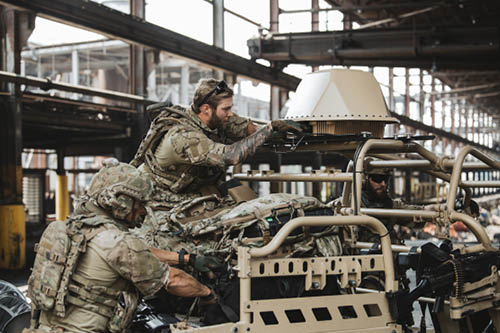
This is not science fiction; it is modern reality – and it is not the only example of grey zone weapons and warfare.
In November 2018, Finnish Prime Minister Juha Sipila said the GPS signal in his country‘s northern airspace was disrupted during NATO ‘war games’ in Scandinavia. He believed the signal had been deliberately jammed by Russia.
China reportedly deploys anywhere between 50,000 to 100,000 ‘hacker army’ cyber warfare personnel within its People Liberation Army, including within the ranks of the infamous PLA Unit 61398, Ministry of State Security, Ministry of Public Security and other agencies.
Such cyber capability is used to bring down networks, hack into systems, deploy ransomware, sabotage elections via ‘fake news’, and other espionage. NATO has recognised cyber and information warfare as the ‘fifth domain’ of warfare alongside land, sea, air, and space. In Australia, ASIO recently warned the threat of nation-state espionage will overtake terrorism as the greatest threat to our security by 2025.
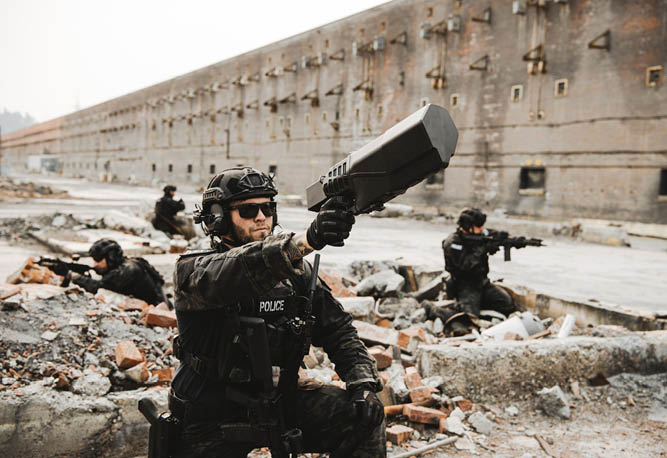
Drone attacks are another increasingly popular tool in this new world of grey zone warfare, including in the Ukraine conflict by Russian separatists scouting positions, and the Nagorno-Karabakh conflict where Azerbaijan has made incredibly successful use of drones in their attacks.
Drones (aerial, land, water, and underwater) make great asymmetric warfare tools due to their low cost and exponentially increasing capabilities, including swarming and autonomous Artificial Intelligence (AI) driven decision making.
Of course, grey zone conflict is nothing new. Moscow Signal was a reported microwave transmission varying between 2.5 and 4 Gigahertz, directed at the US Embassy in Moscow from 1953 to 1976 with the aim of damaging embassy staffs’ health. It resulted in an international incident and widespread fear about ‘invisible threats’.
But a key tenet of military principles is not to look at past conflicts to prepare for future ones. Germany grasped this in WWII, introducing the mechanised blitzkrieg tank in a radical deviation from the WWI horseback battles.
It’s clear the next war will be nothing like previous ones, and it will certainly be high tech.
It may not even look like war to most people – some would argue the level of nation-state based cyber and grey zone tactics in play mean a cold war of sorts is happening now. Hostile governments around the world have grasped the idea of asymmetric war as a means of inflicting material losses on their perceived enemies, with minimal risk of escalation.
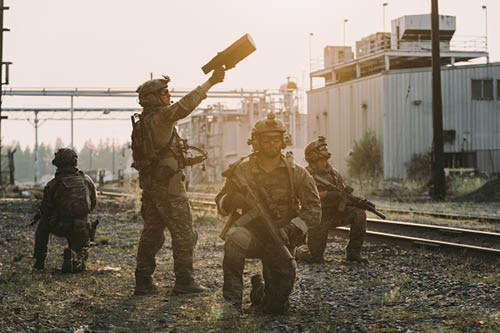
We can combat this, but it requires sweeping changes.
First of all, cyber defence investment must continue across the entire economy and increase in areas of critical infrastructure.
We need to harden the ‘soft targets’ such as undersea cables. Infrastructure like this has now been recognised as critical in a similar way to energy or water plants, so that justifies greater investment.
We also need to invest in more capability to process wide swathes of spectrum across a range of frequencies to understand what’s around us – most asymmetric warfare machines have a ‘spectrum signature’ to them.
Australia also needs a wake-up call to obvious blunders – for example, we should not be allowing the involvement of Chinese nationals in sensitive research work such as university domains. It baffles me how Australian universities often put Chinese nationals forward to their proposed collaboration team, focusing solely on their qualifications and ignoring clear suspicions and links back to the CCP.
I believe construction outfits such as John Holland – owned by US-black-listed China Construction Company – must be immediately banned from access to Defence or other sensitive work.
Finally, we must not sell (and reverse previous sales) of strategic assets such as Port of Darwin to Chinese interests. China’s pursuit of power through foreign asset ownership is well documented and we cannot afford this level of infiltration.
Oleg Vornik
Oleg Vornik is Chief Executive Officer of ASX-listed DroneShield, an Australian developer of technologies including C-UxS/counterdrone, spectrum dominance, AI and machine learning, sensor fusion, electronic warfare and signals intelligence, rapid prototyping and MIL-SPEC manufacturing. www.droneshield.com