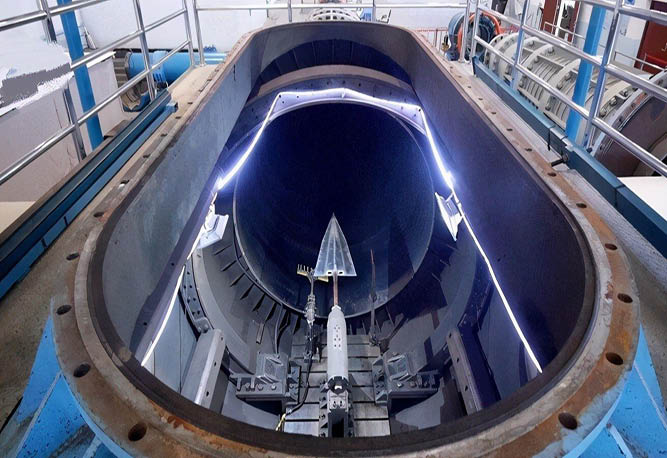

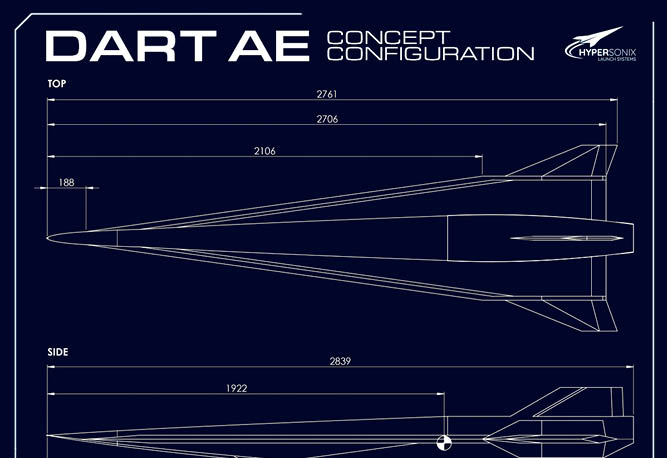
Hypersonix Launch Systems (Hypersonix) — the leading Australian scramjet engine and hypersonic aerospace design and engineering company — is proud to launch the revolutionary DART AE. Entirely made through additive engineering, DART AE is a three-metre-long, single-use, high-temperature alloy, hydrogen-fuelled, scramjet technology demonstrator. It features a mass of 300kg, range of 500km and speed of Mach 7.
DART AE is powered by a single SPARTAN, Hypersonix’s fifth generation scramjet engine. The hydrogen-powered SPARTAN is the world’s first 3D-printed fixed geometry scramjet, delivering performance, reliability, lead time and cost advantages over more bespoke manufacturing methods.
The additive manufacturing production is aligned with key objectives of the Australian Modern Manufacturing Strategy, including the priorities of space, defence and clean energy.
By designing and manufacturing the product entirely in Australia, Hypersonix is proudly contributing to Australia’s Sovereign capabilities, demonstrating industry impact and scale locally and globally.
DART AE can be launched using an unguided sounding rocket — reducing cost and adding flexibility to the launch and payload scenarios. The prototype test launch, powered by an unguided sounding rocket, is scheduled for early 2023.
Earlier this year, Hypersonix completed its shock tunnel testing and vendor selection process. It is now building a hydrogen-powered hypersonic vehicle to demonstrate SPARTAN’s performance and elevate the technology from Technology Readiness Level (TRL) 5 to TRL 7.
Hypersonix is also developing the Delta-Velos Orbiter small satellite launch system — another step in enabling affordable, green, sustainable access to space. This fully reusable system “flies to space” under scramjet power, allowing access to any orbit, from any launch site. Time-to-launch can be just days, compared to months.
The Delta-Velos Demonstrator is a 5.5-metre scaled MVP version of the Orbiter, scheduled to launch Q3 2023. Fully composite and powered by four SPARTAN engines, it will demonstrate reusability, acceleration, and a 2,500 km range.
Hypersonix’s environmental approach to space technology is not new. The company has taken advantage of significant growth in the hydrogen economy to reduce development and infrastructure costs in the operation of its platforms.
Hypersonix’s technology has global applications across the aerospace sector. Fifty thousand small satellites are projected to launch by 2030, with an estimated market worth $19 billion. Rapid growth in the hypersonic technology market predicts a surge from $5.41billion to $12.91billion* by 2031. *BIS Research Global Hypersonic Technology Market Report 2021.
While there are currently over 100 small launch vehicle companies in development internationally, few use green hydrogen as fuel, and none use scramjet technology for small satellite launches. Hypersonix’s “plug-n-play” approach leverages the best available launch provider for the particular Hypersonix mission profile. This reduces technology risk and time to market, locking in a lower cost structure.
Hypersonix has its sights on more than just space. With the aviation industry being mandated to cut 75% of CO2 emissions and 90% of NOx emissions by 2050, there is significant opportunity for Hypersonix’s zero emissions scramjet technology.
With major aviation partners engaged in development with Hypersonix, green flight might take to the skies sooner than anticipated. In the immediate future however, Hypersonix is ready to launch DART AE and start changing space technology for good.