
Space technology and the development of sovereign capability has been the focus of considerable activity in Australia.
Space is a place, a critically important vantage point and communication pathway for achieving outcomes in terrestrial domains. Space is a domain where engineering and science of virtually all disciplines must converge to deliver systems that are part of Australia’s essential toolkit to meet national needs. What makes space special – and inspirational – is that it is the harshest and hardest domain of all to apply technological skills to.
So space technology is the overlap of many deep technologies, and the skillsets required to succeed are those that have been honed through immersive experiences.
The Australian National Concurrent Design Facility (ANCDF) is a national asset that UNSW Canberra Space operates for feasibility studies and preliminary design of space missions. It is available to support the Australian space programme development based on concurrent engineering methodology. The facility was established in 2017 under an Australian Capital Territory (ACT) government grant and in partnership with the French Space Agency (CNES, Centre National d’Etudes Spatiales). It has been conceived for rapid assessment and conceptual design of future Australian space missions (i.e., pre-Phase A to Phase A studies, following NASA’s definitions of mission phasesi).
Australia’s resilience and future success – for national security, prosperity and way of life – relies in part on assured access to space-enabled information and communications. If we are to achieve this, we urgently require a highly skilled future space workforce. In fact, even while government is proceeding cautiously on locking in space programs and procurements, and on stepping up as anchor customer for the domestic space industry, urgent commitment to immersive skills and training programs at universities and vocational education institutions is required if that skilled workforce is to be available in time for procurements and operations. Such talent pipeline investment will be an investment for the entire technology sector, for the reasons described above.
What should deep technology skills and training investment look like?
The best Australian example is perhaps UNSW Canberra Space, at the Australian Defence Force Academy. UNSW Canberra Space is a convergence of tertiary education excellence, both undergraduate and postgraduate; interdisciplinary deep tech research, particularly in intelligent space systems and Space Domain Awareness; mission assurance for national space missions, via the Australian National Concurrent Design Facility; and world-leading technology-demonstration satellite missions.
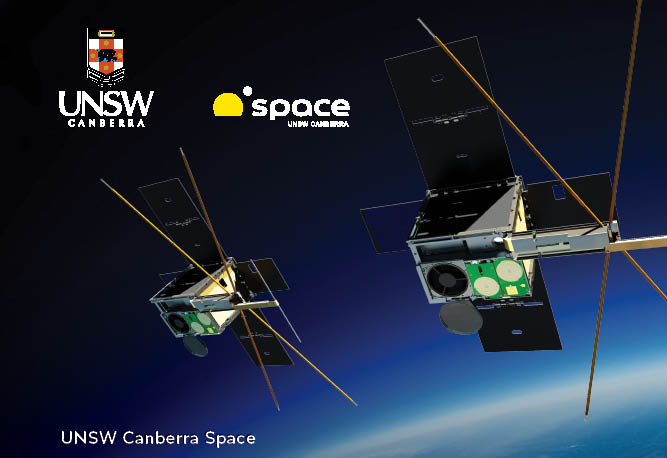
M2 for example, arguably the most complex cubesat mission ever attempted, and operating successfully since March 2021, is currently demonstrating twin-satellite formation flying, multi-modal ISR (~3m pixel-size optical telescopes, and software defined radios detecting and decoding aviation ADS-B beacons and maritime AIS beacons), satellite-relay RF communications, on-board “edge” artificial-intelligence (with recent success in cloud detection from telescope imagery), and more.
M2 is an excellent example of a tech-demo-sat that provides pathfinder data points, raises Technology Readiness Levels, and gives confidence to government and industry in the early stages of large procurements. It’s also an excellent example of real-world deep tech skills and training. Our program has now contributed over 25 highly skilled engineers to the broader technology workforce, and along the way spun off three successful companies.
Multi-year investment in programs and environments like UNSW Canberra Space is a proven and necessary element of Australia’s growth in deep technology skills and capabilities. Honed in space, ready for all domains. Needed now, to prepare Australia for the future.