
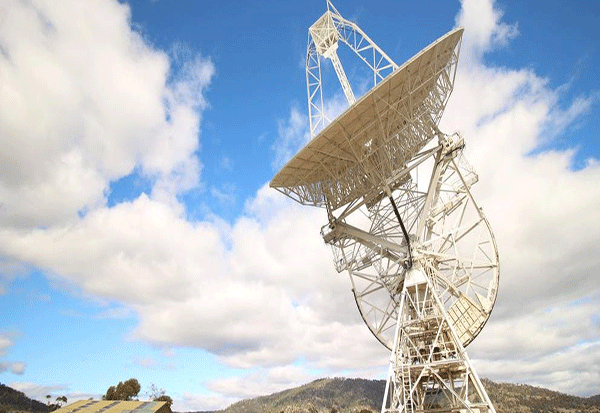
A new communications antenna that will provide ground support to space missions and reduce the chance of collisions for spacecraft has been unveiled at the University of Tasmania’s Greenhill Observatory.
Developed in partnership with the Australian Space Agency, the $2-million antenna was funded jointly by the Australian Government’s Space Infrastructure Fund (SIF) and the University, with the investment designed to help grow the Australian space sector and advance national space infrastructure.
This new and unique infrastructure will provide local and global partners with the opportunity to conduct activities never before possible in the southern skies. It will be operated by a highly-skilled team from the University.
The University of Tasmania is a leader in space sciences and the only University in the world that operates a continental-scale array of antennas.
Professor Simon Ellingsen, Dean of School of Natural Sciences, said the new 7.3-metre antenna 70 kilometres north of Hobart would provide space-to-earth communications for low-earth-orbit satellites.
“This is now the southernmost antenna of its kind in the world, adding to our Southern Skies Network,” Professor Ellingsen said.
“In the past, we have only been able to listen to transmissions from spacecraft but now we are able to transmit messages through radio frequency communications to spacecraft, sending commands as well as receiving data.”
The new infrastructure is also critical to the development of the field of Space Domain Awareness, which allows ground crews to track spacecraft, like satellites and debris in space.
“For the first time we will be able to develop a fully sovereign bi-static radar capability – a more sensitive and accurate form of locating satellites and space-debris – transmitting from the new antenna and receiving reflected signals at other sites across our array, such as the Mt Pleasant observatory 40 kilometres from Bisdee Tier.”
“Globally, satellites are being launched into space at an increasing rate. To launch safely and to keep the assets safe once they are in orbit, we need to know where the stuff already up there is,” Professor Ellingsen said.
“In 2018 there were around 2000 active satellites in orbit, then this doubled in less than two years – in 2020 and 2021 more than 2600 new satellites were launched. In May 2022 SpaceX, one company alone, had launched more than 2300 active Starlink satellites into orbit.
“The growth is exponential, so we are working on innovative techniques and technologies to tackle the challenges this brings, and our new antenna plays an important role in this work.”
Head of the Australian Space Agency, Enrico Palermo, said this new capability further cements Australia’s position as a strong and attractive partner in space.
“Our Space Infrastructure Fund has been critical to address the gaps in our space infrastructure; ensuring Australia can speed up delivery of space-based services and increase its space contribution globally,” Mr Palermo said.
“Australia is deeply experienced in spacecraft tracking and communications, and our geographical advantages provide an added boost to this capability. University of Tasmania’s upgraded facilities will further advance Australia’s expertise in this area and open doors to exciting new research and commercial partnerships.
“Space technology, like satellites, is critical in supporting our everyday life and national wellbeing, and the new antenna will track and protect vital technology in space that we rely on here on Earth.”
University of Tasmania Vice-Chancellor Professor Rufus Black said the University was proud to be partnering with the Australian Space Agency and prestigious space industry partners like SpaceX, Skykraft and Hensoldt to deliver extraordinary new capabilities to the Tasmanian space-related business ecosystem.
“The University has a long and distinguished history of space and astronomy research dating back to the 1950s when the world’s first radio astronomer Grote Reber moved to Tasmania to pursue his research,” Professor Black said.
“Reber saw the undeniable value of our unique geographic situation, close to the geomagnetic pole and perfect for viewing the southern skies and southern lights ‘Aurora Australis’; since then, we have developed a world-class team and infrastructure that supports their work.
“Tasmania’s future as a high-tech gateway to space is bright.”