
Professor Simon Ellingsen
Launching stuff into space has never been more accessible or more affordable. Companies like SpaceX, RocketLabs and locally, Gilmour Space Technologies, are offering commercial launch options that have opened access to space for SMEs and academic researchers, as well as the development of new, disruptive product offerings such as Starlink. In 2019 approximately 100 satellites were launched, the next year it jumped by more than a factor of 10, to 1200. It is continuing to increase year on year. Another illustrative example is that in 2018 there were approximately 2000 active satellites in orbit and as of May 2022 there are more than 2300 active Starlink satellites.
Space is big, so it’s not exactly crowded up there, but it is getting busier quite quickly. The objects are also moving at speeds which are difficult for us Earth-bound humans to comprehend. The international space station is moving at a speed of 7600 metres per second, or to put it in more comprehensible units about 27000 km per hour. That is literally faster than a speeding bullet and the consequence is that collisions between a satellite and other objects can have catastrophic consequences. So knowing what is in space and where it is, is very important. The technical name for this is Space Domain Awareness (SDA), sometimes called Space Situational Awareness (SSA). To keep active satellites and any crewed space missions safe, its critical for us to monitor both active satellites and “space junk”. Space junk is everything from inactive satellites and bits of rocket body, to fragments produced by previous collisions between satellites or from the demonstration of anti-satellite capability that have occurred a number of times in the last decade.
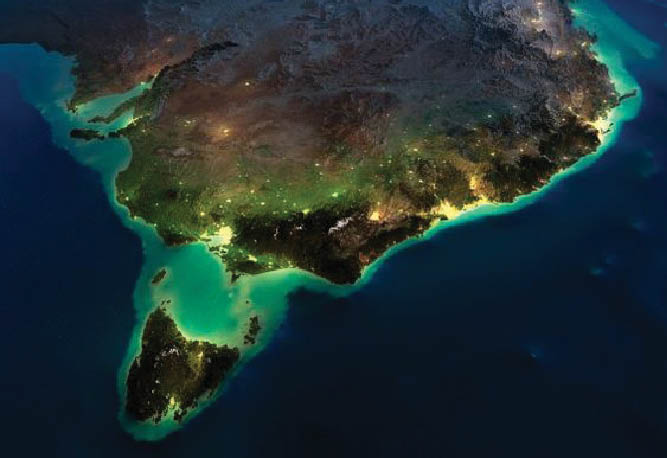
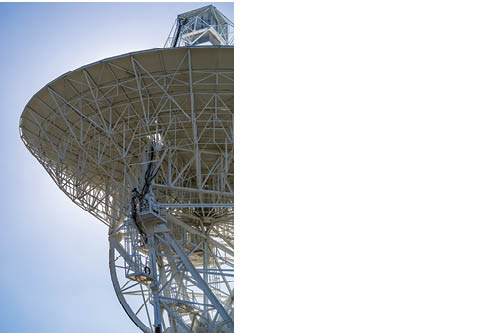
Space Domain Awareness has traditionally been a role undertaken by government and in particular the military with the United States Space Command publishing the most widely used catalogue of objects. However, sensors and methods which have been developed over a period of time where we launched around 100 satellites a year do not scale to cope with a factor of 10 increase in activity. So the flow-on effect of cheaper, easier launches is that we now are in urgent need of new SDA sensor capability and new methods for analysing and synthesising the data they collect. This is where Southern Guardian comes into play. Southern Guardian is a collaboration between the University of Tasmania, HENSOLDT Australia and the Tasmanian State Government. The collaboration is bringing together a continent-scale array of sensitive antennas owned and operated by the University of Tasmania, the radar expertise and information management systems of HENSOLDT and the geographic advantage of Tasmania to develop new sovereign SDA capability, with applications in both the civil and defence spheres.
There is no single sensor type that can provide all the SDA information that we require. We need some sensors that can simultaneously track large numbers of objects with modest precision. We also need a suite of sensors that can focus in on specific objects of interest and obtain precise data to determine if a “conjuction” – that is SDA jargon for a collision between two objects in space – is going to occur. Furthermore, we need systems that can take the information streams from the various sensors and bring them together in such a way that decisions can be made as to when collision-avoidance manoeuvres are necessary.
The University of Tasmania and HENSOLDT Australia have been demonstrating the capability of the systems they are developing in the SpaceFest Lite exercises. The very broad and high frequency range, along with the sensitivity of the sensors, provides a unique capability, as showcased in the only cislunar capture by the Pacific cell in the April 2022 SpaceFest Lite. Watch this space for more exciting developments which will be tested in SpaceFest Lite events later in 2022 and 2023.
Simon Ellingsen is Professor in Physics and Dean of the School of Natural Sciences at the University of Tasmania.