
What is Australia’s space division, and why is it in the military?
It is official, planning is underway for the Australian military to launch its own space division in 2022, with its Chief already appointed.
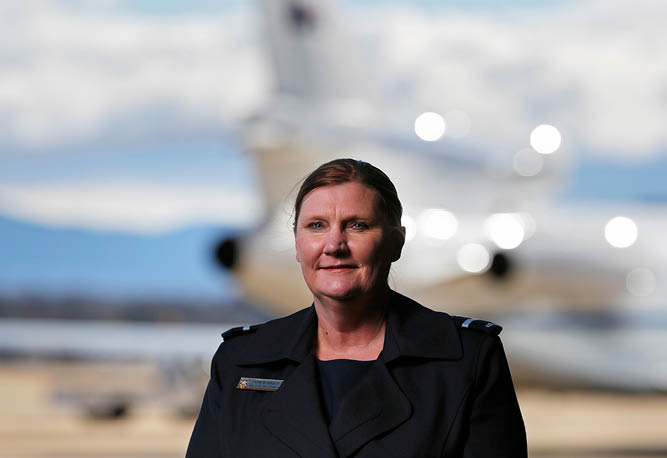
In May it was announced that Royal Australian Air Force Air Vice-Marshal Catherine Roberts will lead the division from January.
The newly created military space command, which will draw on all aspects of the Australian Defence Force, will “allow us to establish an organisation to sustain, force-generate, operate space capabilities and assign them to a joint operation command if needed”, according to RAAF Chief Air Marshal Mel Hupfeld.
The RAAF Chief has said previously that unlike other nations like China and Russia, Australia would not seek to develop technologies to attack enemy satellites.
But what does that mean? Why is the proposed Australian space division in the military? And how does it compare to others around the world?
Why does Australia need a space division?
As far as international movers and shakers in space defence go, you may think Australia is a bit player.
But while we may seem like small fry when compared to the likes of the US, Australia already has an impressive track record in communications and observation satellites, said Cassandra Steer, space law lecturer and mission specialist with the Australian National University’s Institute of Space.
These satellites are particularly important for farming and mining in remote areas, for instance.
The Australian Defence Force declined to comment on the division’s aims, but protecting these assets is what the new space division will likely focus on, Dr Steer said.
“We’re facing a huge problem of space debris and space traffic management at the moment, just because of the sheer number of objects we are continuing to launch into space.
“I have to keep updating my numbers because SpaceX launches every two weeks, but there are about 3,800 operational satellites in orbit, and an estimated 128 million pieces of debris [smaller than 1 centimetre].”
What the division will not do is weaponise space, nor use it to wage war.
If not for war, then why is the division in the military?
The Australian Space Agency was set up only a few years ago, and it, among other roles, regulates and authorises space-based technology such as weather and land-monitoring satellites.
So why does the space division need to sit within the military, if war isn’t on the cards?
Alongside people in remote corners of Australia, pretty much every aspect of daily life across the nation involves satellites, whether that be banking, weather forecasting or health services — or military purposes.
So essentially, Dr Steer said, the issue of “space traffic management” is a safety and security threat.
A local space division will let the military develop and sling small satellites into orbit that will not only keep an eye on space debris but help people on the ground investigate further should a suspicious collision occur.
“If something happens to one of our own satellites, particularly the new Defence satellites that we will have in the next five to 10 years, [we could ask] was that a nefarious attack? Or was it just a bit of space debris?” Dr Steer said.
“It’s really hard to know unless you have proper capabilities to track what’s in space, and that’s what [Australia] will be excellent at — small satellite launch.
“It’s what the 21st-century space industry is about, much more than launching huge things or launching humans.”
Having a space division within the military also plays a role in space diplomacy.
How nations use space is governed by the Outer Space Treaty, which entered into force in October 1967 and forms the basis of international space law today.
It was developed primarily as an arms-control treaty for the peaceful use of outer space by the US, the Russian Federation and the UK.
“The Soviets and the US and their allies realised that if they wanted to have continued access to space for important technologies, they needed to restrain themselves and each other,” Dr Steer said.
Globally though, countries have in the past 10 or 15 years started to turn away from that “strategic restraint”, she added.
“It’s quite concerning.”
A space division in the military will allow Australia to join its allies “and temper the greater powers away from what’s happening, and back towards strategic restraint”.
How will it compare to other countries?
Quite a few countries, such as Canada, France, Japan and India, have set up similar divisions, or sections, within their military.
Most recently, the UK Space Command officially formed on April 1 this year, and is staffed from the Royal Navy, British Army, Royal Air Force and civil service.
The outlier is the US Space Force. It was formed in December 2019 and is the sixth branch of the US military, the first new US military service since the Air Force was spun off in 1947.
After initially raising eyebrows, the US Space Force has drawn criticism for its less-than-peaceful efforts.
In September last year, for instance, a Space Force squadron was deployed to the Arabian Peninsula, following months of escalating tensions between Iran and the US.
“The rhetoric of the US Space Force is actually very problematic,” Dr Steer said.
“It’s starting to set a bit of an escalatory cycle in place, because what [the US] is doing is saying, Russia and China are weaponising space, therefore, we need to weaponise space in return.
“But China hears them saying that, and so they ramp up their program, and so does Russia.
“And so it becomes this back and forth, a little bit like the Cold War.”
What does the role of commander entail?
While Air Vice-Marshal Roberts will take the reins as commander of Australia’s space division in eight months, exactly what her role will involve is not yet clear.
But by coordinating Australia’s space defence activities, Air Vice-Marshal Roberts will get a feel of the nation’s strengths and weaknesses, and likely set about fixing any vulnerabilities, Dr Steer said.
“Intelligence is another big part of what we use space for and what Australia has done really well in, so she’ll be bringing all of those capabilities under one banner head, so that it can be better coordinated.”
Having one person in charge of the military’s space activities will also allow Australia to better coordinate with, in particular, the Five Eyes allies: the UK, Canada, New Zealand and the UK.
“This is a great way to be able to coordinate at the same level as our allies,” Dr Steer said.
“We need to have someone who’s able to speak at that level, because most of our allies have someone at that level.”
By ABC Science Reporter Belinda Smith
Key points:
- Australia’s space division will include personnel from the Royal Australian Navy, Australian Army and Royal Australian Air Force
- Defence capabilities will likely focus on protecting Australia’s space-based infrastructure such as satellites
- It’s still in its planning phase, but the space division should let Australia better coordinate space defence activities with allies